Sarah Steinkamp
Operation NapoleonSarah Steinkamp is the widow of Leo Stiller, an American pilot whose questions about a Nazi plane on Vatnajökull Glacier make her a crucial, though indirect, witness to the book’s central mystery. Living among photographs of a family lost in the war, she has kept both the images and the account Leo gave her: the plane emerged from the ice in 1967, then disappeared again.
Background and Marriage
Sarah and Leo were both Jewish. They met in Hungary after the war, when Sarah’s family had been killed and she had little left beyond photographs. A neighbour in Budapest had saved the pictures; Leo tracked him down, took Sarah in, and helped recover the one surviving record of her family. She continued to keep those photographs with her, and told Kristín that Leo had insisted she retain her maiden name, Steinkamp.
The photographs are more than decoration in Sarah’s account. She explains that the people in them are all dead and calls the frames mourning frames. The images preserve faces and relationships that war had otherwise taken from her; Leo’s recovery of them links their marriage to his effort to find the neighbour who had kept them safe. Her attachment to the pictures gives a domestic, intimate history to a woman whom others describe mainly through her grief.
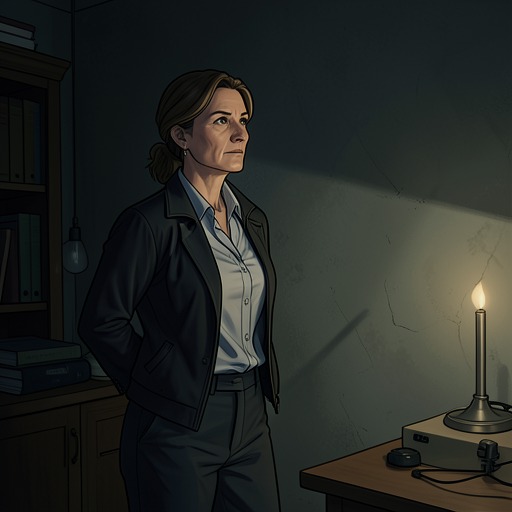
Sarah’s devotion to Leo remains explicit in the way she speaks of him. She says that he saved her life and wonders what would have become of her had he not found her. That gratitude sits alongside her conviction that the official account of his death was wrong: although authorities called the helicopter crash an accident caused by a mistake, she insists that Leo was a perfectionist who checked his work and did not make mistakes. Her certainty is a personal judgment, not proof that his death was deliberate, but it explains why questions about him remain charged.
Life in Reykjavík
By the time Kristín and Steve seek her out, Sarah lives on the ground floor of a small, dilapidated wooden house in the old Thingholt district of Reykjavík. Its corrugated-iron cladding has rusted away near the ground, the small windows are single-glazed, and the green paint on the front door has mostly flaked off. A large fir stands in a garden whose wooden fence has rotted and largely collapsed. The worn house establishes the setting for a guarded encounter rather than offering a secure refuge from the past.
Michael Thompson has given Kristín and Steve Sarah’s address, hoping she may clarify Leo’s theories. He says he visits every few years out of regard for his former commanding officer, but describes Sarah as difficult, angry, bitter, and depressive, and says he never stays long. His account is limited to those visits and his own impression; it does not replace Sarah’s own testimony. When Kristín and Steve arrive at about seven in the morning, after escaping the base and walking north from Hafnir, they approach cautiously, still wary of pursuers.
Sarah first appears behind the window and keeps the door chained when she opens it a crack. She is very small, and speaks English with a strong European accent that Kristín suspects may be Eastern European but cannot place exactly. Her first response to hearing Leo’s name is to stress that he is dead; when Steve explains that they want information about him, she asks what they want with her Leo. Her suspicion makes the interview difficult, but she eventually chooses to answer.
Leo and the Glacier Plane
Sarah’s knowledge of the plane comes from Leo, not from her own participation in the flights or the military search. She tells Kristín and Steve that Leo knew about the aircraft on the glacier and said it belonged to the Nazis. She also recalls that he made a fuss about it at the base: the authorities wanted to cover the matter up, while Leo wanted to know what was happening and could not tolerate the secrecy. Her account therefore connects his private concern to an institutional effort to suppress discussion, without establishing exactly what he learned or who ordered the concealment.
Michael Thompson supplies a separate piece of context. He recalls rumours that the military was searching for a plane with extremely dangerous cargo, and says regular monitoring flights crossed the country and the sea to its north. Once a month, Leo organized flights over the southeastern section of Vatnajökull Glacier to photograph the ice. Thompson never saw anything himself; from time to time, however, those responsible for the flights believed they had spotted something worth investigating. His recollection corroborates the existence of repeated surveillance, but its uncertainty contrasts with Sarah’s confidence that Leo knew the aircraft was Nazi.
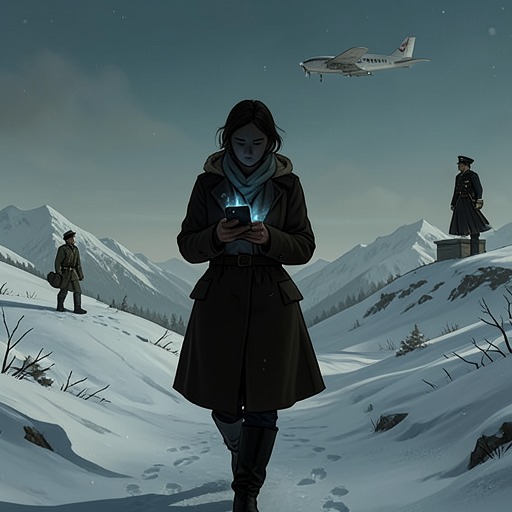
Asked what Leo had told her, Sarah says the plane appeared out of the ice and then vanished again. She dates this to 1967. Her explanation is that Leo described the glacier as capable of burying the plane and later revealing it again. The statement gives the mystery a specific year and a physical pattern of concealment and return, while remaining a report of Leo’s words rather than a direct account of what Sarah saw. She does not provide an explanation for the plane’s cargo or for the authorities’ actions.
Testimony and Significance
Sarah’s testimony is important precisely because its limits remain visible. She can convey what Leo told her about the plane, his anger at secrecy, and his belief that the glacier had exposed and reburied it; she cannot supply the documents, operational details, or complete history behind those claims. Elsewhere, the story reveals that badly weathered German papers recovered from a metal case bear the words Operation Napoleon, while Colonel Miller later says even he did not know the operation’s full contents. Sarah’s recollection thus forms one fragment in a larger chain of partial testimony, not a final explanation.
Her account also preserves a contradiction that the official language of accident cannot settle. The authorities treated Leo’s death as a mistake; Sarah remembers a careful pilot who would not have made one and a man who had refused to let the plane’s disappearance pass without question. The narrative neither turns her suspicion into established fact nor dismisses it as grief. Instead, Sarah’s loyalty, the recovered family photographs, and her memory of Leo’s insistence on answers show how the hidden military history reaches into private life—and how the people left behind may retain evidence that official accounts omit.